
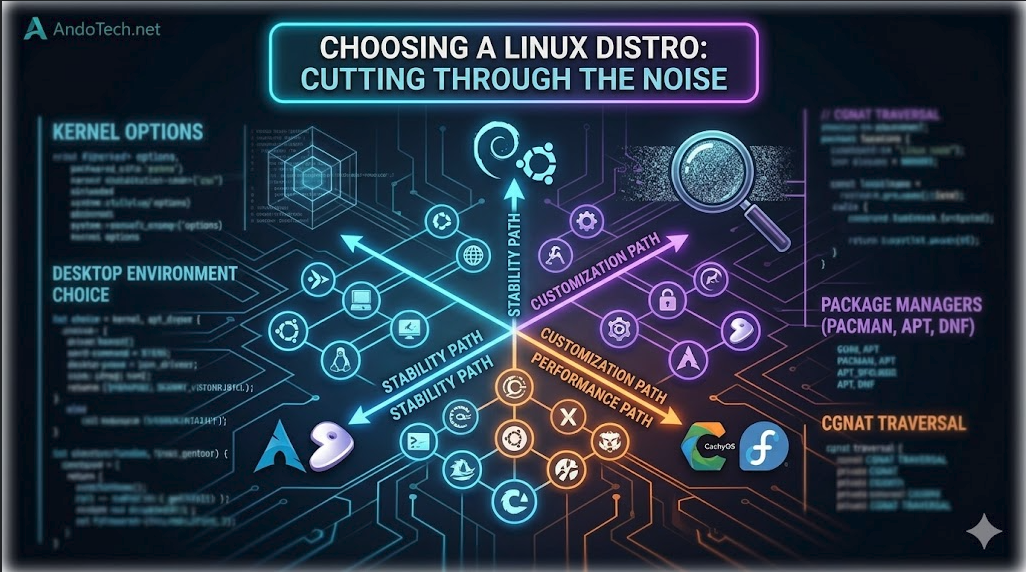
💡 Quick Take: Finding Your Linux Family
Choosing a Linux distribution isn’t about the default desktop look; it’s about the underlying ecosystem and release philosophy. Almost every major distro belongs to one of three primary family trees:
- The Debian/Ubuntu Family: Focuses on stability and predictability above all else. Software versions are thoroughly tested and frozen for years. Best for: Servers and “set-and-forget” environments.
- The Red Hat/Fedora Family: Focuses on integrating cutting-edge open-source technologies quickly, without sacrificing system stability. Best for: Systems administrators and developers.
- The Arch Family: Focuses on simplicity, full user control, and a rolling release model where the system updates continuously forever. Best for: Enthusiasts and performance seekers who want the latest software.
Introduction
If you ask ten Linux users which distribution (“distro”) you should install, you will get ten different answers. The sheer volume of choices can be paralyzing. You’ll see beautiful screenshots of customized desktops, hear passionate debates about package managers, and read endless forum threads defending one operating system over another.
But here is the secret: underneath the logos and the default wallpapers, most Linux distributions share the same core DNA. Choosing a distro isn’t about finding the “best” operating system; it’s about finding the release philosophy and package ecosystem that match your specific goals.
Let’s cut through the marketing noise and look at how Linux distributions are actually built, so you can make an informed choice.
The Three Pillars of Linux Families
Almost every major distro on the planet belongs to one of three primary “family trees.” When you choose a distro, you are really choosing its underlying ecosystem:
1. The Debian/Ubuntu Family (The Enterprise Standard)
- The Philosophy: Stability and predictability above all else. Software versions are thoroughly tested and frozen for years at a time.
- The Ecosystem: Uses
.debpackages and theaptpackage manager. Because of Ubuntu’s massive market share, almost every software developer targets this family first. - Best For: Servers, critical production environments, and users who want a “set-and-forget” system where nothing changes until the next major release.
2. The Red Hat/Fedora Family (The Innovation Hub)
- The Philosophy: Integrating cutting-edge open-source technologies quickly, but with enterprise-grade engineering.
- The Ecosystem: Uses
.rpmpackages and thednfmanager. Fedora is often the first to adopt major architectural shifts (like the Wayland display server or PipeWire audio). - Best For: Systems administrators, developers, and users who want new software features without sacrificing system stability.
3. The Arch Family (The Powerhouse)
- The Philosophy: Simplicity, control, and cutting out the middleman. The system starts completely bare, allowing you to build up exactly what you need without any pre-installed bloatware.
- The Ecosystem: Uses the
pacmanmanager and features a rolling release model—meaning your system updates continuously forever, rather than making you reinstall every six months. It also gives you access to the Arch User Repository (AUR), an unparalleled safety net containing almost every Linux application in existence. - Best For: Enthusiasts, power users, and performance seekers who want bleeding-edge software updates and complete sovereignty over their operating system configuration.
For users who want the power of a rolling release but want their operating system tuned for maximum performance right out of the box, the ecosystem has evolved.
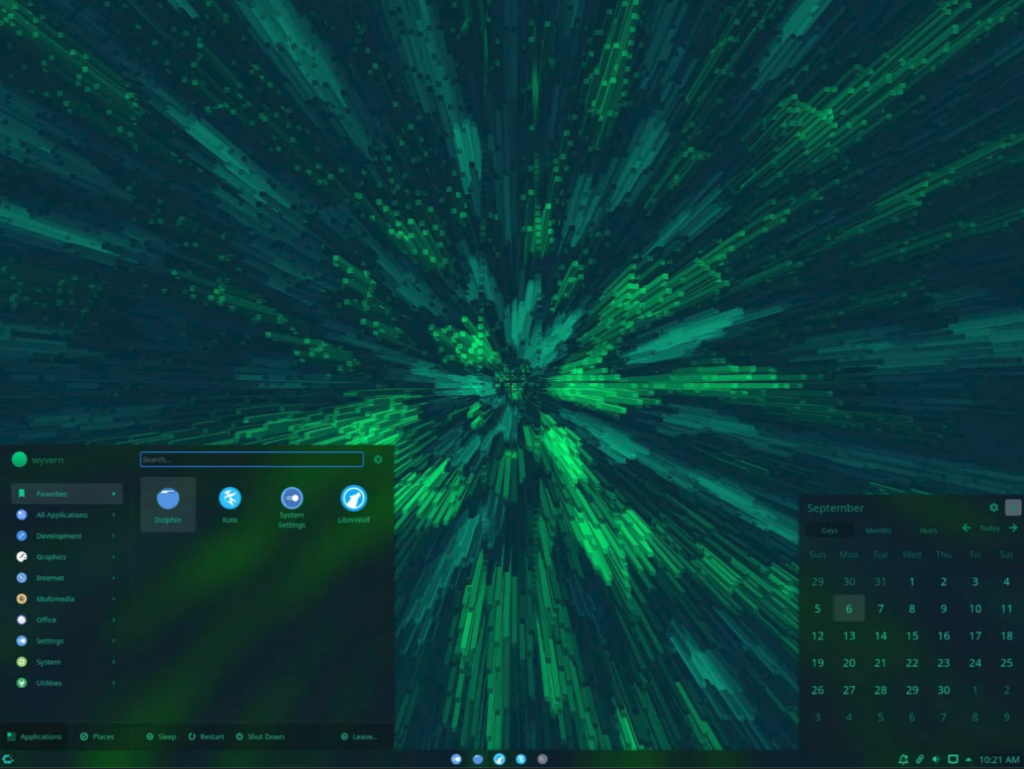
Distributions like CachyOS take the rock-solid foundation of Arch Linux and compile the entire operating system with advanced CPU optimizations. While a vanilla Arch install requires experienced users to manually build everything from a bare terminal, CachyOS provides a polished, user-friendly graphical installer and a fully configured desktop right out of the box. After a year of testing, it has proven to be stable and solid enough for beginners who want maximum desktop responsiveness without the complexity of a manual Arch setup.
Bleeding-Edge Performance: The Optimized Spin-Offs
The Verdict: How to Decide
To pick your direction, ignore the flashy desktop environments (you can install any desktop on any distro anyway). Instead, answer this single question: How do you want your updates?
- If you want a system that stays frozen in time and never surprises you: Go with Debian or Ubuntu LTS.
- If you want a great balance of modern tech and stable releases: Go with Fedora.
- If you want the absolute latest software, complete control, and maximum hardware performance: Step up to the Arch ecosystem (or an optimized derivative like CachyOS).